Archaeologists dug up Schaghticoke's mill-town past. The 143-page report is now online.
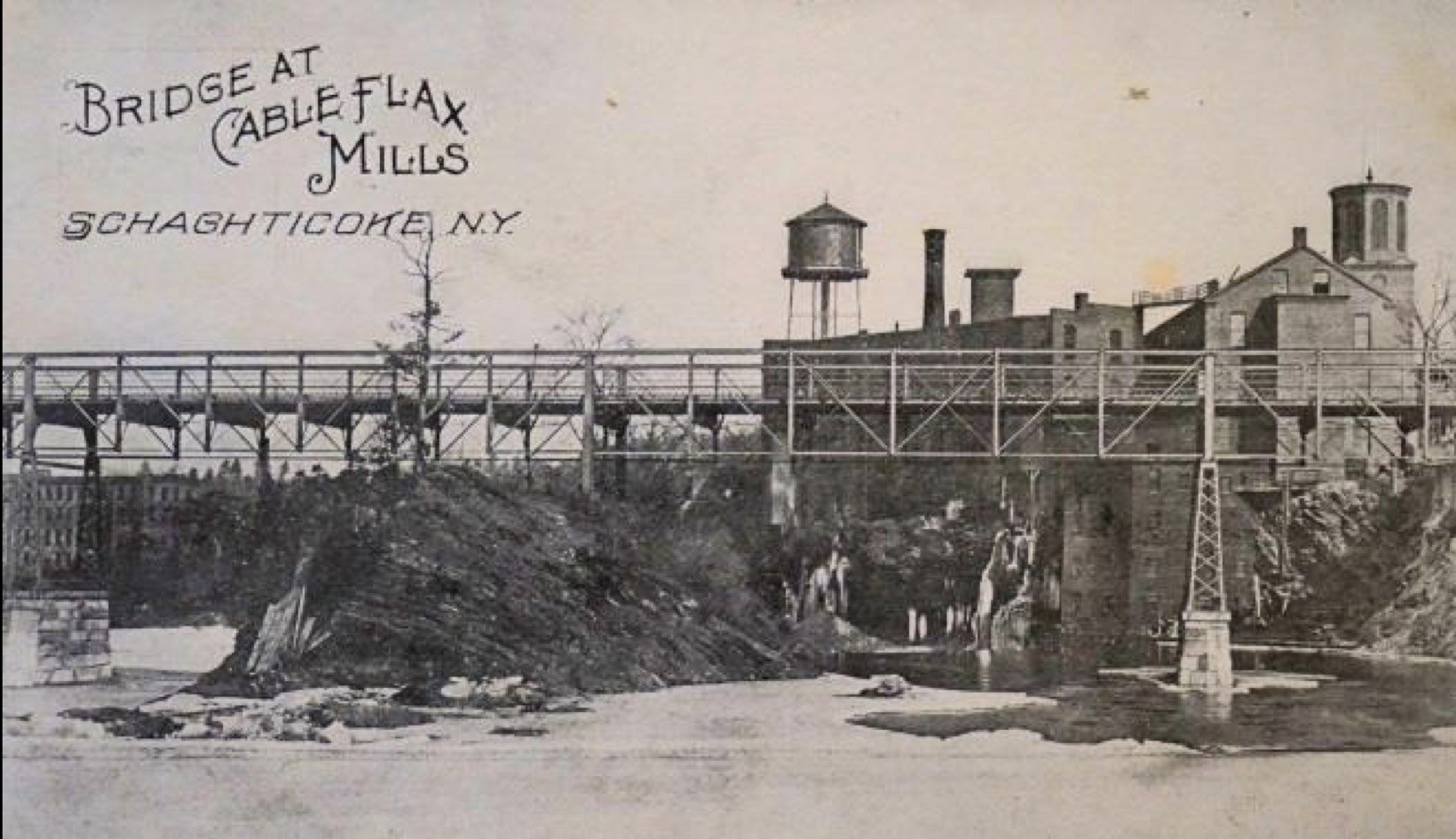
Sitting quietly on the town’s new History page is something remarkable: a 143-page study called Schaghticoke, New York: A Nineteenth Century Mill Town — the most substantial published history of this town’s industrial past that we’ve encountered anywhere.
Read it here → (41MB PDF — the town’s copy, with our backup behind it)
Why archaeologists were digging in Schaghticoke
When the state replaced the 1941 Route 40 bridge over the Hoosic River, federal law required archaeological surveys first. The New York State Museum’s Cultural Resources Survey team — Robert Dean, Michael J. Lenardi, and Mark S. LoRusso — spent the project excavating along both approaches to the bridge, and found thirteen historic sites: the houses and shops of mill workers, and pieces of the factories that once dominated every aspect of life here.
The result, published in 2019, is that rare thing: a rigorous academic study about us — and it’s written to be read, with over a hundred maps, historic photographs, and pictures of what came out of the ground.
The town the river built
The report’s history sections explain why Schaghticoke industrialized so early: the Hoosic’s dramatic elevation drop and deep gorges made it a perfect place for water power. Flour and saw mills gave way to some of the region’s earliest textile factories, and by the 1830s mills lined both banks. The partnership of Troy financier Richard P. Hart and local operator Amos Briggs built some of the largest textile works in the area — first rope, twine, duck cloth, and sacks; later some of the finest woolens in the country.
Two human details stand out. When Richard Hart died, his widow Betsey Hart ran the investments herself — her 1886 obituary put her fortune at over $7 million, making her one of the independently wealthiest women in the United States, and Amos Briggs owed her as much as $40,000. And the mills drew waves of immigrants: the study documents a neighborhood of Irish workers’ houses at the south end of the village, below Mill Street and Second Street, that everyone simply called “Dublin.”
What came out of the ground
The everyday material is the best part. From one house lot alone, excavators recovered more than 8,600 artifacts — broken table ceramics, bottle glass, kitchen bones and shells, buttons, glass marbles, a coin, smoking-pipe fragments, even a 1904 sports pin. It’s the physical record of ordinary mill families’ lives, the kind of history that never makes it into official records. The report also traces every bridge at the crossing back to 1788, with construction photos from the 1941 build.
The local connection
Readers of our history page will recognize a name in the bibliography: the study repeatedly cites the research of Schaghticoke’s own Town Historian, whose blog we’ve drawn on for our Speigletown history as well. The dig sites are in the village, a few miles north of Speigletown — but it’s the same river system, the same Route 40, and the same town, and the textile economy it documents is the world our own Grant’s Hollow cradle factory and Kool Kill mills belonged to.
The study is a NYS Education Department Cultural Resources Survey publication (Series 9, 2019), produced for the Route 40 bridge replacement. We mirror a copy so the link keeps working: if the town’s copy ever moves, ours is here.
Have a tip, correction, or issue of your own?
Submit to the Reader →