A crossroads called Dort
Speigletown sits along New York State Route 40, northeast of Troy and near the Hudson River, which forms the boundary with Saratoga County. Permanent settlement dates to around 1668, but the hamlet's first portrait comes in 1796, when the surveyor Flores Bancker laid out the little settlement on a piece of parchment, "by a scale of 100 feet to an inch." He called it the village of Dort.
That parchment plat, still preserved, shows three roads fanning out from a common point — the road north labeled the "St. Coick" (North Hoosick) road, the one running east "Cooksburgh road," and the one south "Lansingburgh road." Around them Bancker penciled the names of the first families: Follet, Douglas, and the partnership of "Rattoon & Von der Spiegel." It is that last name, the Dutch Vanderspiegel family who settled the southern Schaghticoke region, that eventually gave the place its own. Curiously, the spellings of Speigletown and Vanderspiegel never did line up, and the old records don't say why.
Two towns, one hamlet
Speigletown's town line has moved more than once. Before 1819 the land belonged to the Town of Schaghticoke; that year the northern strip — Speigletown and neighboring Pleasantdale — was annexed to Lansingburgh, where it stayed for the next 81 years. Not until 1900 was the area restored to Schaghticoke, where it remains. The homecoming was a mixed gift: it handed the town miles of road to maintain for a district that counted only about sixty voters south of the Deep Kill.
Geography made the hamlet a natural crossroads. The Northern Turnpike — opened in 1800 as the county's earliest north–south road, and now Route 40 — ran right through it. What is now Fogarty Road was part of the old SanCoick Road winding toward Hoosick Falls and on to Bennington, while Irish Road led west to the Hudson River Turnpike (today's River Road), following the Kool Kill past a scatter of saw mills and a flax mill. By 1850 the settlement at the Route 40 and Fogarty crossroads had a school, a church, a hotel, a tavern, and a blacksmith shop.
A country village, and a summer escape
For a place this small, Speigletown drew a remarkable amount of company. When the automobile arrived to join the old turnpike traffic, the hamlet became an easy escape from the city: Troy residents came out for sleigh rides and hotel dinners, bicycle-club outings, clam steams, and hikes up Rice Mountain, long described as the closest, most accessible hill climb to Troy. East of the village on the Cooksborough road, a mineral spring drew such Sunday crowds that in 1870 a group of Troy investors dreamed of tubing it and building a resort — one newspaperman wondering whether "the vulgar old patronymic Speigletown" might yet "surrender to the more euphonic" name of Baden-Baden. (It did not.)
The hub of all this was the hotel at the crossroads, the "Union Hotel" on the 1854 county map and the "Rice Hotel" by 1861. Under Theodore Ray in the 1880s it became a genuine destination — advertised as a "first-class hotel" with a dance floor, summer boarders, even a telephone, by which "a physician may be summoned, a telegram sent, or any order given to the market man … as readily at Speigletown as in the heart of the city." Behind the hotel, in Valentine Perry's field, the sporting men of the district held their pigeon shoots.
The families who stayed
Two families run like threads through the hamlet's history. Three generations of James Rice — grandfather, son, and grandson — farmed at the crossroads and kept the public house there, eventually holding some 400 acres; the last of them, James L. Rice (1848–1917), split his time between the farm and a hardware-and-seed business in Troy. Their name still looms over the hamlet as Rice Mountain.
The Perry family farmed the other corner. Aaron Perry (1781–1863) built a small fortune and a large reputation for lawsuits — his obituary noted a "passion for litigation" — while his descendants worked farms along Fogarty Road into the 20th century and lent their name to Perry Road. It was two of them, Albert and Caroline Perry, who would later turn the family's east-side acreage into the Green Acres subdivision. Alongside these landowners ran the shopkeepers: the Dusenberry family kept the village general store from about 1910 into the 1950s, on the site that later became the LaPosta and then the Barton store.
A society for catching horse thieves
Long before the town had a police force, its farmers made their own. In 1831 the men of Schaghticoke banded together as the Schaghticoke Society for Apprehending Horse Thieves and Robbers — a mutual-protection club of the kind common across rural New York, when a stolen horse could cripple a farm and the nearest lawman was hours away.
The society's printed constitution — this copy lists its members as of January 1, 1866 — spelled out the rules: a dollar to join and a quarter a year after, a slate of officers and ten managers, and, at its heart, fourteen "Riders or thief pursuers" who could be sent out the moment a member's horse went missing. A rider earned a dollar seventy-five a day plus expenses while in pursuit; a pursuer who ignored the call forfeited five dollars to the treasury.
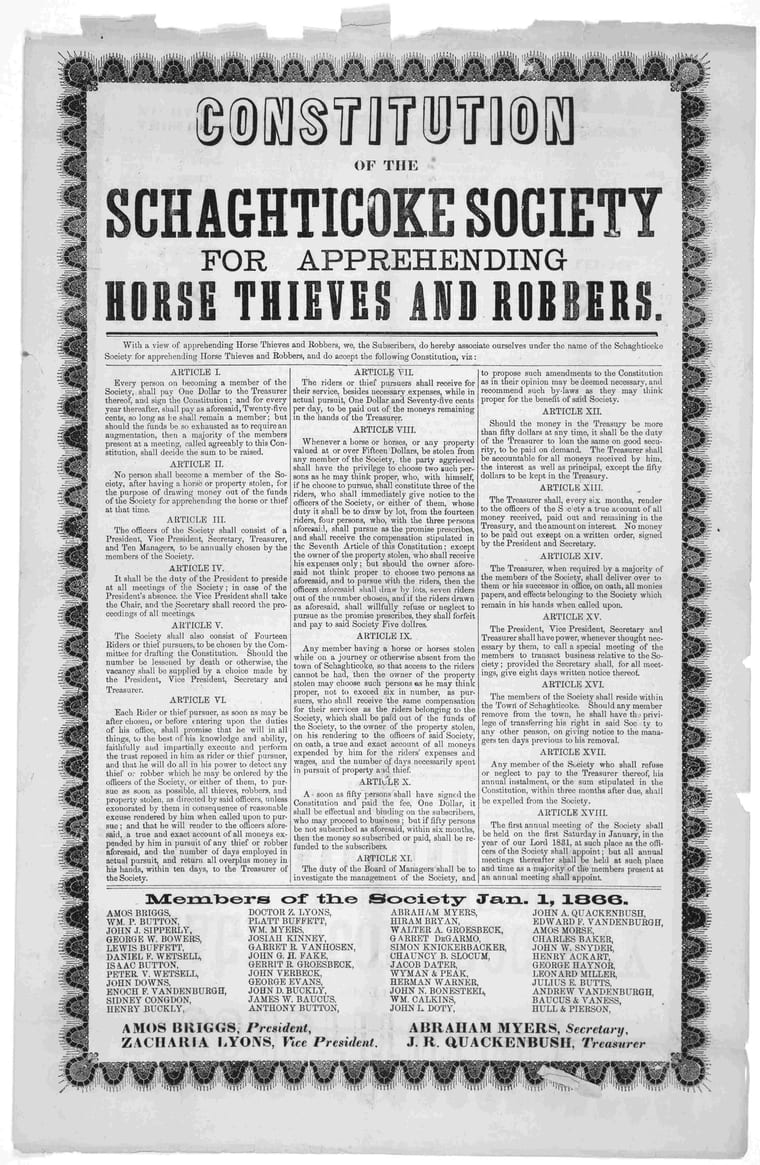
The membership roll reads like a census of the town's old families — Buttons, Sipperlys, Baucuses, Groesbecks, Vandenburghs, a Knickerbocker, a Doty — many of the same names that turn up on Speigletown's farms and in its hotels. The broadside survives today because a copy found its way into the Library of Congress.
The tea room and the dairy bar
Two roadside institutions gave the hamlet its mid-century flavor, and both still stand. The Willow Tea Room, opened about 1925 by William Henry and Rena Dodd opposite the junction with Brickyard Road, broke with the area's saloons and hotels by serving no alcohol at all — just waffles, creamed chicken, and homemade ice cream. For twenty years it was the place for a wedding shower, a banquet, or a retirement party. Named for a 150-year-old willow that finally came down in a 1957 storm, the building was moved about 100 feet east when Route 40 was rebuilt around 1930, and was renovated again beginning in 2020.
A stone's throw away, Anderson's Dairy Barn opened in 1934. Edward Anderson — an R.P.I.-trained engineer who chose dairy farming, and a charter member of the Speigletown Fire Department — grew a small "dairy bar" into the restaurant that survives today as the Rustic Barn.
Neighborhoods take shape
As Troy workers looked for room to breathe, the farmland along Route 40 began filling with houses. Sunset Heights, on the west side behind today's Tesman's Garage, grew from a summer colony in the 1920s into a year-round neighborhood with its own community association. On the east side, near what is now Transfiguration South church, the Perrys subdivided Green Acres in 1937 under famously strict deeds — one-family homes, no flat roofs, garages set discreetly to the rear, and hedges kept below four feet. Farms held on along Fogarty Road and Calhoun Drive even so; Fogarty Road itself carries the name of Timothy Fogarty, an Irish immigrant whose family worked their 245-acre "Meadowview" dairy there from the late 1800s well into the 20th century.
The newcomers brought their own histories. Two Sunset Heights residents, Clyde Heer and Thomas DeLee, had come home decorated from the First World War — Heer as a battalion sergeant major who went on to found a well-known Troy real-estate firm, DeLee as a sergeant who built a chain of early self-serve grocery stores and left his name on DeLee Drive.
The hometown paper
For nearly a century, Speigletown and its neighbors had a newspaper of their own. The Schaghticoke Sun began publishing in 1894, chronicling the doings of the southern town — and at times appearing in local editions as the Melrose Sun, Easton Sun, Valley Falls Sun, and Johnsonville Sun. Much of its earliest record was lost when the old Methodist Church building that housed the paper burned. The Sun ran its presses for 89 years before stopping in 1983 — and the area has had no paper of its own since. That gap is a good part of why this site exists.
Speigletown has always been a place people passed through — and a place people chose to stay. That tension between crossroads and community is still its character today.
Help us tell it
This is a summary drawn from the historians and archivists who've done the real digging. If you have photos, documents, or family stories from Speigletown, we'd love to help preserve and share them.