Step out on a clear night in Speigletown and you can still see a sky that much of downstate has lost — the Milky Way on a good night, and stars that fade the moment a neighbor’s floodlight snaps on. A bill working its way through the Legislature in Albany, the Dark Skies Protection Act, would set the first statewide rules for outdoor lighting in New York. It’s still in committee, but because it would reach ordinary homes and businesses — not just big installations — it’s worth understanding now, well before its proposed 2028 start.
This is a plain-English rundown of what the bill actually says, where it stands, how it would be enforced, and what it would and wouldn’t mean for a rural hamlet like ours.
What the bill would do
The act would add a new Article 18, “Light Pollution Control,” to the state’s Environmental Conservation Law. Its stated purpose is to “preserve and enhance the state’s dark sky while promoting safety for people, birds, and other wildlife, conserving energy and reducing our carbon footprint, and preserving the aesthetic qualities of the night sky.” Three provisions do the real work.
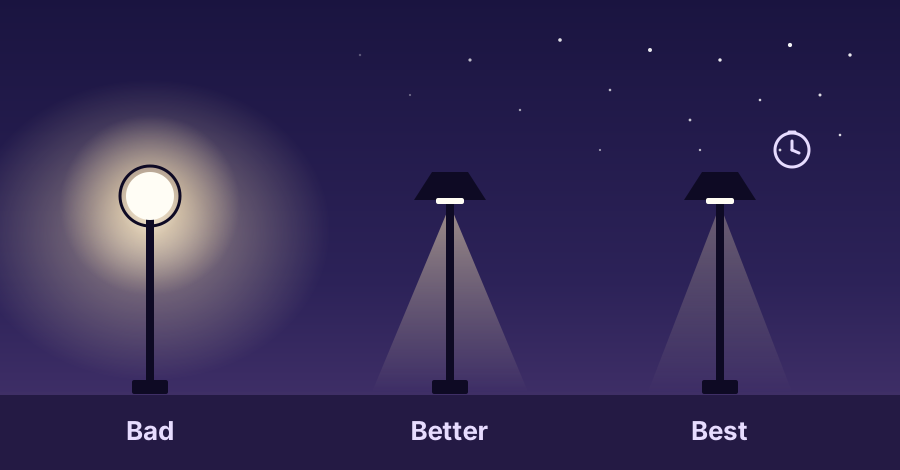
Shielded fixtures, starting 2028. The core rule: after January 1, 2028, all outdoor lighting fixtures would have to be “shielded” — residential, commercial, industrial, and municipal alike. “Shielded” has a specific meaning in the bill: the light has to be projected below a horizontal plane running through the lowest point of the fixture. In plain terms, the light points down at the ground it’s meant to light, not sideways into a neighbor’s window or up into the sky. This is the same “full cutoff” idea behind the dark-sky-friendly fixtures already sold at any hardware store.
Late-night limits at recreational facilities. No outdoor recreational facility, amphitheater, or arena — public or private — could be lit between 11 p.m. and 5 a.m., unless an event was already underway before 11 p.m. Think ball fields and stadium-style lighting, not a porch light.
Older fixtures can stay — with a catch. Fixtures that don’t meet the shielding standard would still be allowed if they shut off automatically or manually between 11 p.m. and sunrise, or if they’re motion-activated, last less than fifteen minutes, and shut themselves off. So a bright, unshielded security light isn’t banned outright — but it can’t be left blazing all night.
What’s exempt
The bill carves out a long list of exemptions, and several matter locally:
- Lighting needed for worker safety, “including but not limited to lights at agricultural facilities, industrial, manufacturing, or commercial sites.”
- Emergency lighting used by police, firefighters, or medical personnel while an emergency is happening.
- Small and decorative lighting — incandescent fixtures of 150 watts or less, and other sources under 70 watts, “including but not limited to seasonal and decorative lighting.” Holiday lights, in other words, are not the target.
- Airport and aircraft-safety lighting, highway and tunnel lighting, and lighting for road or municipal-building construction.
- Streetlights where a shielded version isn’t available from the manufacturer.
The most recent Senate version (S9637-A) adds two more: a defined area of New York City, and fixtures deemed culturally or historically significant on application.
Where it stands in Albany
The act has been introduced more than once, in both houses:
- In the Assembly, A4615 was introduced in February 2025 by Assemblymember Deborah Glick (with Assemblymembers Schiavoni and Simone), referred to the Environmental Conservation Committee, carried into the 2026 session, and on February 10, 2026 reported and referred to the Codes Committee.
- In the Senate, S5007 was introduced in February 2025, and an amended version, S9637-A, was reprinted in March 2026.
What that means in practice: the bill is still in committee and has not passed either house. To become law it would have to clear both the Assembly and the Senate in the same session and then be signed by the Governor. If that happens, the text sets the effective date at January 1, 2028 — and directs the state to begin writing the necessary rules before then. If it doesn’t pass before the session ends, it would have to be reintroduced. In short: nothing changes tomorrow, and the earliest anything takes effect is 2028.
What it would mean for Speigletown homes
For most households, the practical picture is modest. After 2028, new outdoor fixtures would need to aim their light downward — the kind of fixture that’s already common and often cheaper to run because none of the light is wasted going sideways or up. Existing lights wouldn’t have to be torn down; putting them on a timer, a dusk-to-dawn control that clicks off after 11 p.m., or a short motion-sensor would keep them compliant. Holiday and low-wattage decorative lighting is exempt outright. The neighbor’s dusk-till-dawn “barn light” that glares across three yards is exactly the situation the bill’s supporters have in mind.
What it would mean for local businesses
New commercial construction is where this would bite first, because a building going up after the rules take effect would simply be designed to meet them from the start — shielded parking-lot poles, downward-aimed sign and wall lighting — rather than retrofitted later. Speigletown has two ready examples right on Route 40: the new Ragone Concrete building near Fogarty Road, nearing completion, and a new Dollar General planned for the corner of Route 40 and East Schaghticoke Road. A store or yard built after the effective date would have its lot poles, wall packs, and lit signage designed as shielded, downward fixtures from day one — which also tends to trim the electric bill. There’s one wrinkle worth knowing for industrial sites like a concrete yard: the bill exempts lighting needed for worker safety at industrial, manufacturing, and commercial sites, so much of that task lighting could qualify, while parking-lot, sign, and architectural lighting would still be expected to be shielded.
For businesses already open, the shift would be gradual rather than a demand to go dark. Existing fixtures can stay — as long as they’re shielded going forward, meaning at the next replacement or relighting, or switched off after 11 p.m. if they aren’t. The recognizable examples are all around us, and most are in our local directory: the lit parking lots and illuminated signs at La Posta Brothers Market and Tesman’s Service Station on Speigletown Road, at Hilltop Bowl on Hansen Road, and at the Rustic Barn Pub. None of these is a target in itself — the aim is downward, shielded light rather than glare thrown sideways and up. A big-box store’s tall parking-lot poles are the classic case the bill has in mind, and also one of the easiest to fix: flat-lens, downward-aimed fixtures light the pavement just as well while keeping the glare out of the sky and out of the houses next door.
The takeaway for any business planning to build or renovate: designing compliant, shielded lighting into the plans now is far cheaper than swapping out fixtures after 2028. It’s also generally lower on the electric bill.
The local-control angle
One part of the bill matters more than it looks. Its provisions are “cumulative and supplemental” and would not apply in any municipality that has already adopted local light-pollution rules that are equal to or stricter than the state’s. In other words, if the Town of Schaghticoke were to adopt its own dark-sky standards, the town’s rules would govern here instead of the state’s.
That’s relevant because outdoor lighting is already something the Planning Board weighs when it reviews a commercial site plan. Whether or not the state act passes, lighting on new development is a local decision made right here, and residents can raise it at those public meetings.
How enforcement would work
Because the act lives in the Environmental Conservation Law, it would be administered by the state Department of Environmental Conservation (DEC). The bill as written leans on standards and education more than on a spelled-out penalty schedule: it directs DEC to publish educational materials and compliance guidance on its website — examples of conforming fixtures, allowable older fixtures, and the exemptions — and to write any regulations needed before the 2028 start. The finer points of enforcement, including any penalties and how complaints are handled, would come through that DEC rulemaking rather than from the bill’s current text. Locally, the most likely touchpoint is the front end: lighting reviewed as part of a building permit or site plan for new construction.
Weighing it
Supporters make a real case:
- Darker skies and fewer stars lost to skyglow — something a rural hamlet still has to lose.
- Less light trespassing onto neighbors’ property, a recurring backyard complaint.
- Lower energy use and cost when light is aimed where it’s needed instead of scattered.
- Benefits for migrating birds, insects, and other wildlife that a wall of night-long light disrupts.
Critics and cautious observers raise fair concerns too:
- A statewide mandate reaching residential fixtures strikes some as a heavy hand for a problem better handled town by town.
- Real, if usually modest, costs to replace or retrofit non-compliant fixtures, and questions about what counts as “reasonably available” shielding.
- Worries that dimmer commercial lots could feel less safe, even where studies on lighting and crime are mixed.
- Uncertainty until DEC writes the rules — the current text leaves enforcement details for later.
The bottom line
The Dark Skies Protection Act is not law, and won’t change anything before 2028 even if it passes. But it points in a clear direction: outdoor light that does its job without spilling into the sky or the yard next door. For a place like Speigletown, that’s less an imposition than a description of what a lot of us already want on a clear night. We’ll keep an eye on the bill, and on whether the town takes up the question locally.
Sources: New York State Senate bill texts A4615, S5007, and S9637; reporting by CBS News New York and WHEC. This is an explainer, not legal advice; confirm current bill status and any adopted rules before acting.
Have a tip, correction, or issue of your own?
Submit to the Reader →